

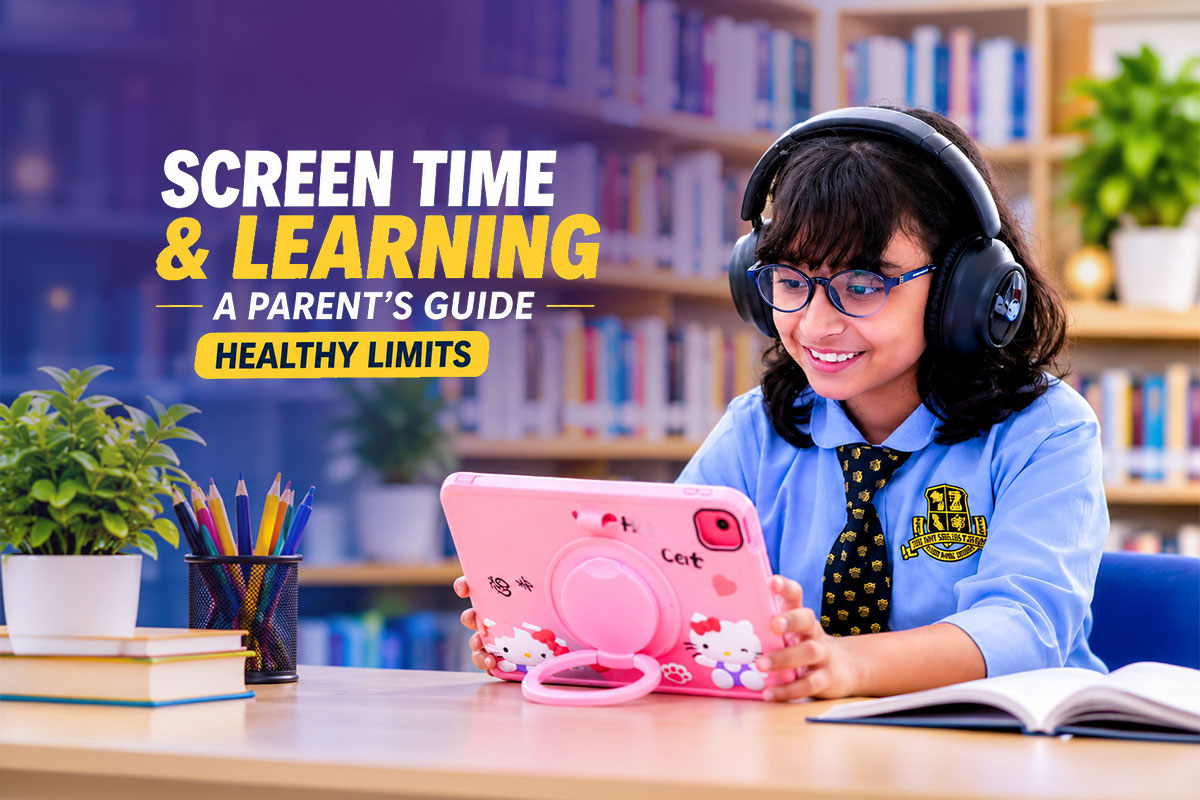
Screen Time and Learning: A Parent's Guide to Healthy Limits.
Picture a Tuesday evening at home. Homework is open on a tablet, a video
tutorial is playing, and a message from a friend pings in the corner of the
screen. Is your child studying or getting distracted? Honestly, it is both, and
that is exactly why screen time for children has become one of the trickiest
questions in modern parenting. The good news is that you do not need to ban
screens altogether. Good screen time management for kids simply starts with
understanding them.
The first thing to know is that not all screen time is equal. Time spent
on a device can mean two very different things. A child building a model in a
coding app, video-calling a grandparent or watching a science documentary is
doing something quite unlike a child scrolling through short videos on
autopilot. It helps to ask what they are doing: whether they are creating,
learning, connecting or just consuming. It also helps to monitor when it is
happening, whether before homework, during meals or right before bed, and what
it is replacing, whether sleep, play, reading or family time. If screens are
crowding out sleep, movement and face-to-face conversation, that is your signal
to adjust, whatever the clock says.
This matters for learning because a developing brain needs variety. The
effects of screen time on children often show up first in sleep and attention,
and both are central to screen time and learning. At The Hope English School,
one of the British schools in Sharjah, we see how well rested, curious children
settle into lessons. Sleep is when memory gets consolidated, so late-night
screens can quietly undermine what your child learned that day. Constant
notifications also train attention to jump around, which makes deep, focused
work such as reading a chapter or solving a tough maths problem feel harder
than it should. Physical play, reading on paper and even a little unstructured
boredom are never wasted time. Boredom is often where imagination begins.
Many families find it easier to build healthy screen time habits by
dividing the home and the day into four zones. The homework zone is simple: one
device, one task, and notifications off, with the phone kept in another room.
The meal zone means no screens at the table, because dinner conversations are
surprisingly powerful. The sleep zone asks that devices charge outside the
bedroom and that screens go off at least an hour before bed. Finally, there is
a free zone, perhaps weekends or a few set evenings, when your child chooses
how to spend their screen time within agreed limits.
Of course, the right approach changes with age. Younger children need
firmer boundaries set by parents, while older children and teenagers do far
better when they help create the rules, because they are much more likely to
follow limits they helped shape. Whatever their age, digital habits for
children are shaped far more by what we do than by what we say. If we scroll
through dinner and then ask them to put their phone away, the message gets
lost. Try a family challenge instead, with a screen-free hour every evening for
everyone, parents included. You may be surprised by who struggles most.
Sometimes, despite everyone's best efforts, it is not working. Watch for
warning signs such as irritability when a device is taken away, falling grades,
disturbed sleep, losing interest in hobbies or friends, or secretive behaviour
online. If you notice these, respond with curiosity rather than punishment, and
ask what your child enjoys about it before laying down new rules. As a British
International School in Sharjah, we believe in holistic development and in
working as partners with parents, because a child's wellbeing at home and in
school are never separate stories.
Technology is not the enemy of learning. Used with purpose, it opens
doors that our children's grandparents could only dream of. Our job is not to
keep screens away but to help children grow into people who know when to put
them down.
If you are a parent searching for a school in Sharjah that supports
healthy digital habits for children alongside academic excellence, we would
love to welcome you. The Hope English School offers a quality British education
that nurtures confident, balanced and well-rounded learners.